Tuesday, 21 December 2010

Istanbul

It felt good to be ending our trip in Istanbul. Making it to the point where Europe merges with Asia felt like a tidy spot to stop. We met a Kiwi couple, Emma and Justin, who had cycled a similar route to us across Europe and were now living in Istanbul. They had also met Amin and his friends who run the bike rental shop in Sarajevo and stayed with Amin while they were there. They had loved Sarajevo too. Emma and Justin are keeping busy with work and study until it gets warm enough to continue on through Asia and back home to NZ. They are still planning a route but it sounded like it would be a lot more challenging than what we had justdone. They are keeping a blog and we are looking forward to following their progress at Rolling Tales. Good luck guys!

As for us, the only planning we had in mind was how to sample as many varieties of Turkish delight as possible!


We stayed in a Hostel on the less touristy side of the Golden horn in a area called Beyoğlu that includes the Galata tower. We were following advice from other travellers who found the tourist district a bit busy to be based  in all the time. It's sound advice if you're spending longer than a few days in Istanbul as you still have close access to the sights but avoid the hard sells and higher prices of the Sultanahmet area. Beyoğlu is also a bustling art and cafe/bar area of Istanbul with the super busy shopping street İstiklal Avenue at the top of the steep hill. Our hostel (Neverland) was great for us, being relaxed and with a cafe down below that was a good place to drink tea and meet locals and other travellers.

I don't think I'd ventured into a mosque before coming to Istanbul and was a little worried that my lack of knowledge of the customs would make for a bit of an uncomfortable experience. The mosques in the tourist areas are expecting sightseers however and when prayers are not on will guide you through so to avoid making a faux pas. It felt pretty relaxed inside anyway with kids running around and people chatting. The huge blue mosque in particular had a lovely interior that felt light and serene. The fact that mosques only use patterns to decorate their interiors gives them a different feel to Christian churches. Most Christian churches tend to be rich in figures of angels and saints looking out from the walls and stained glass which gives a strong sense of history. The feeling we felt in the mosques we visited felt more meditative and lighter. Perhaps someone brought up in the culture would have a different reaction being more familiar with the symbolism of the intricate patterns but to us it felt a lot less heavy than the old churches we had visited so far on our trip.     


The call to prayer varied a lot across the city. The locals don't appear to notice it as it starts up but we never really got used to it enough not to stop and listen for a while. In some areas the singers were amazing and it echoed around the buildings or trees and was haunting and beautiful. In other areas (like just outside our hostel room) the speakers on the mosques are turned up too high and have blown so what you hear sounds more like a Dalek singing. Still pretty cool sounding but a bit jarring to hear at sunrise.

Underground inside the ancient Basilica Cistern - once a water filtration system for the main palace of Constantinople.


An upside down Medusa head at the base of a pillar inside the cistern. 


Wednesday, 15 December 2010

Turkey drawings


Above - The very friendly cat that lived at our hostel, here sleeping on the heater. 

Wednesday, 8 December 2010

Rabbit of Fortune


We weren't wandering around Istanbul long before we spotted a roadside fortune rabbit. We were drawn to the sight of a man standing next to a tall platform with a rabbit perched patiently on top. We were used to seeing vendors selling animals on the side of the road in other places we had visited but it seemed a bit odd to be selling a single rabbit displayed on such an extravagant platform. We suspected there was something else going on. We saw a few variations with small bunnies and a rooster accompany the main rabbit but it wasn't until we noticed a small draw with little squares of paper in the cabinet that we started to understand what was going on . The next day I noticed one of the platform drawers was marked "English" and the other "Turkish" as we passed and saw our chance.

The man called his young friend over who was selling socks and he instructed me in English what I was to do.

First I was to give the bunny a pat.
"He is very patient" I commented.
"Also very smart" my instructor added seriously.
The rabbit did appear to be concentrating quite hard at this point.
Then the man opened the drawer and placed the rabbit in front of the small folded squares of paper.
The rabbit looked at them for a while sagely. Then he picked one out nimbly with his teeth and the man handed me my fortune.
My fortune seemed a bit obscure to me.....
 Not so keen on that end part,  but all round well worth the three lira.
We talked to a Turkish girl later about the fortune rabbits and she told us its an old Turkish tradition and features in many Turkish films. Will have to watch some when we get home. Who knows perhaps we could start our own fortune rabbit business if we are stuck for work once we are back in Melbourne.

Sunday, 5 December 2010

Eating on cycle tour

Lots of places will have wild fruit for the picking. A yummy Serbian apple.
We were mostly cooking for ourselves during our cycle trip - it was cheaper but also a lot easier for our picky diets. I am allergic to gluten and Jenny's vegie which can be hard to figure out how to avoid when eating out without an English menu (even with an English menu can be difficult when it comes to gluten). It was a bit of  a shame in that we didnt get to sample a lot of local dishes but it did mean we stayed healthy on the road and didn't get frustrated ordering things we couldnt eat. 

When we were planning the trip we had no idea what would be available in the countries we were passing through in terms of our diets. We were a bit nervous about finding nutritious food that we could eat. We also didnt  have any experience of cooking with our new mini gas cooker and saucepan. Short camping trips back home consisted of bake beans, bbq's and beer which didnt seem like an appealing staple for months on end. We did a few experiments with different meals and narrowed down some good staples to keep on the bikes. We could find most of these "staples" in every country we travelled through, although replacing spices (we carried lots of Indian ones) was sometimes difficult.
                                                                 Before our main trip we had a few smaller excursions in Scotland where we conducted experiments cooking different dishes.  A lot of our home cooking was quite easy to pull off on the little cooker but sometimes we would have to simplify a bit.
Capsicum season in Serbia. Stuffed peppers galore!
We thought it might be useful to give some details of the food we found handy to carry and a recipe we enjoyed  using a lot on the road. It's food to suit our taste but it may be good as a framework if you're planning a big trip on bicycles.
First here's a list of staples that we found you can get most places and are pretty versatile, filling and easy to prepare.
Rice = Easy to get everywhere and cheap.
Lentils = Find green or red varieties in most places. Cheap.  
Oats = Harder to get the further east we traveled in Europe. Great breakfast with any fruit going. We use water instead of milk, fine once you're used to it.
Oil = hard to get small quantities for carrying. We transferred to drink bottles as the oil lids would always spill.
Yogurt = Available everywhere and usually very cheap (especially in the east). Varies dramatically in thickness and fat. Quality from good to amazing. (France and Germany tight contenders for flavoured yogurt supremacy).
Veg = onion and garlic are always good for a meal base, then add whatever other veggies are available. We found carrots consistently good. Broccoli is wonderful to use but was often pretty sad looking during the summer heat. Seasonal fruit and veg is definitely worth using. Even if you are not of fan of a something back home, local varieties can be taste sensations. Giant sweet strawberries in Belguim that taste a bit like rockmelon, sweet rich Italian tomatoes, Croatian grapes like lollies, Serbian capsicum...
Bananas = Available everywhere and great for energy.
Nuts = Easy and cheap. We found peanuts the most versatile.
home grown taste tops!
Chocolate =  amazing variety. Good emergency energy.
GELATI!


cooking in our hotel room in paris. Classy.
So here it is, our favourite meal we made on our trip........

Lentil Curry 
serves two
Cooking oil
One diced onion
Half a bulb of garlic (diced)
Half a cup of lentils (red lentils will cook quickest) 
Ginger (diced)
One large carrot.
Yogurt
Optional = Broccoli, Zucchini, Spinach or Soy chunks
Spice = 
2 tsp of Cumin seeds or a bit less of powder.
1 tsp of Chili or more for kick.
2 tsp of Turmeric
1 tsp of cinnamon
2 tsp of Garam Masala
Salt to taste.

 Heat oil in pan and add the spice as it warms. Add and brown onions then garlic. Add the rest of the vegies and cook for five minutes or so. Stir in Lentils and mix in a cup of water. Keep adding water as it simmers when it's looking dry. Add salt and ginger. Should take about ten minutes but test the lentils and it should have a porridge consistency.
Its good served with yogurt on the side and peanuts on top. The one pictured below also has soy chunks which just need soaking in water while you're preparing the rest and added with the veggies. They soak up the flavour and have a chicken like texture.
Lentil curry. It tastes better then it looks!
Happy cooking!

Sunday, 28 November 2010

Veliko Tarnovo

From Sofia, we took the train to two other smaller cities in Bulgaria - first Plovdiv, then Veliko Tarnovo. Plovdiv has a lovely old town with Ottoman style architecture and windy cobbled streets, and we spent a relaxing two nights there before jumping on a train to Veliko Tarnovo. Hostel Mostel, the excellent hostel we stayed at in Sofia, also have a hostel in Veliko Tarnovo and I have to admit that was one of the things enticing us there. We were not let down, the hostel was excellent and we met some great characters there too including a man named Girard who we spent much of our time there talking to. Girard is from Newfoundland, Canada (his friends call him "Newfie") but has been travelling since the late 70s - he pauses now and then to work for six months, then he is off on the road for a few more years. As you can imagine, he is filled to the brim with thoughts and experiences. Even though he is getting older, Girard was so full of vitality and energy that he had the presence of a young man. He has a strict diet now due to a particularly grisly bout of intestinal worms that he was lucky to survive but it sounded like his past was quite reckless in terms of drinking and drugs. We both thought he kind of resembled Iggy Pop in looks and demeanor. He had recently travelled through Central Asia and his stories and impressions were fascinating. Girard travels without a bank card (he only recently acquired a bank account, but still doesn't have a card - so travels with mountains of cash on him), he has no email account, no cell phone, and carries only a small well-worn leather over-the-shoulder bag (he has been through three of these over his 30+ years on the road). We so enjoyed our time with Girard and part of me was sad I couldn't just add him to Facebook and keep track of what he is up to - but a bigger part of me was excited to have met someone travelling in this nomadic and free style, a dying breed!


Veliko Tarnovo was under Ottoman rule from the 14th century until a successful uprising in the late 19th century. In 1913, there was a big earthquake which caused much of the city to be rebuilt, thus most of the Ottoman style architecture was lost. One of the workers at our hostel told us that the story of the "huge earthquake flattening the town" was somewhat suspicious and quite possibly the people used an earthquake as an excuse to rid themselves of the Ottoman history surrounding them and rebuild anew.

After a relaxing three nights in Veliko Tarnovo, we boarded the night train to Istanbul, and spent the night pretending to be on the Orient Express.

Saturday, 27 November 2010

Thursday, 25 November 2010

Rila Monastery

Rila Monastery was founded in honour of Saint Ivan of Rila, the patron saint of Bulgaria. In English he is usually called Saint John because apparently Ivan is the Bulgarian version of the name John (!!), these names don't sound very similar to me so I will stick with "Saint Ivan". Saint Ivan is a legendary Bulgarian hermit who lived over 1000 years ago. He was a herder who became a monk when he was 25. Eventually he became a recluse, living in complete solitude (apart from wild animals) and without material possessions in a tiny, cold, uncomfortable cave, where he devoted himself to prayer. According to legend, wild animals came right up to him without fear, and birds would land in his hand.

We took a day trip from Sofia out to Rila Monastery, heading first to the nearby cave where Saint Ivan lived. The cave was small and dark, and required exiting out of a tiny hole in the top in order for us to "cleanse ourselves" of our sins. A bunch of young male hooligan tourists were yelling and chest-beating at the exit to the cave as we arrived, obviously relishing their clean slate.
         Kari climbing out of Saint Ivan's cave (sin free!)
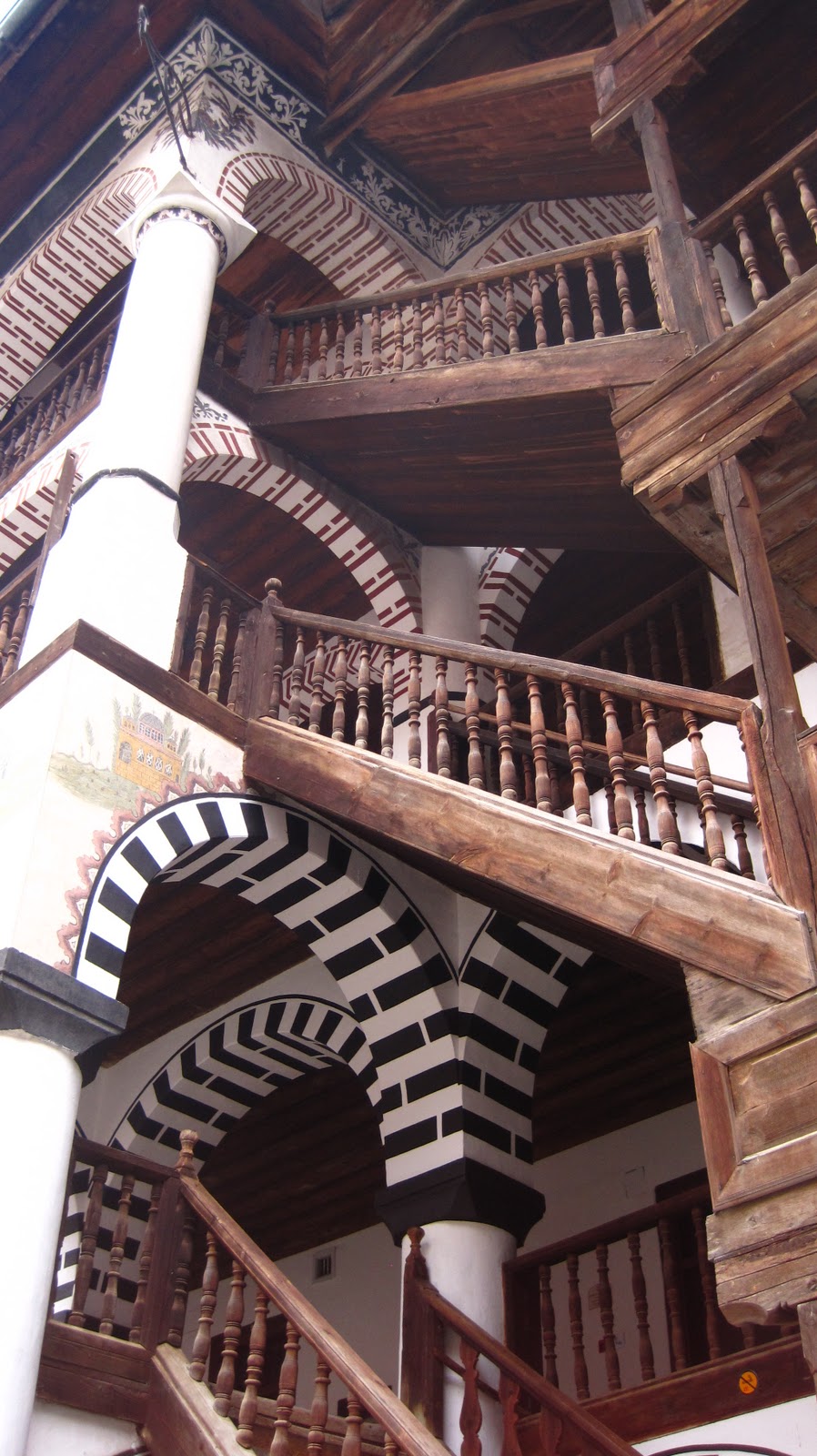
Rila Monastery is over 1000 years old (re-built at various times), believed to have been founded by students of Saint Ivan of Rila. The size and grandeur of the complex is certainly in sharp contrast to Saint Ivan's miserable wee cave! Outer walls of the cathedral are covered in fascinating murals, and the inside of the cathedral is decadent and impressive, it felt like every square millimetre was filled with ornate and intricate detail (and lots of gold). The entire place and setting felt old, with evidence of an old way of life happening around the complex - a donkey was led in carrying a load of fresh produce, work of artisans was on display and the Monastery felt like a haven for traditional Bulgarian culture as well as religion. The practice of Christianity felt strong throughout Bulgaria, and when we visited churches in Sofia they were filled with people in prayer, purchasing icons, talking to priests, etc - quite different to a church filled with tourists taking snaps (Notre Dame was the worst for this!)


Above = tiny doorway at a little convent church we visited on the way (with a lovely window and rather frightening fire & brimstone murals)


Spot the monk on a mobile!!

naughty but gorgeous resident puppy