Saturday, 11 September 2010

Rural Serbia


We cycled out of the congestion of Belgrade across the Danube and the landscape quickly turned rural. There is still a fair bit of heavy industry in this north eastern corner of Serbia so the ride wasn't always so idyllic but the towns were always filled with interesting characters and cafes.
The coffee is delicious in this part of the world - ground super fine and strong but without being bitter. It seems most people have it quite sweet and without milk. This one (above) came with turkish delight.

many cafes and resteraunts are set on the rivers.

view from our camp spot
 lovely peaches and capsicum off this roadside cart


We stopped for our morning coffee in Vracev Gaj and meet the owner Mita who chatted to us in fluent English. He gave us some advice on our trip south through Serbia after Romania and places of interest. We were excited to learn his wife is from the small town of Visegrad which we planned to visit as it is the setting of the excellent novel, the Bridge Over the Drina. Was lovely to be able to communicate with a local and we spent an hour or so chatting. We also met Sasha and his boys (also pictured). Sasha had returned to his home in Serbia after working in Italy in his twenties. He told us Serbians have an affinity with the Italians, and they both spoke so fondly of Italy that it made us look forward to being there in a few weeks time.


long steep climb to the entry to Romania

Tuesday, 7 September 2010

Belgrade

We rode over the Sava river into central Belgrade and were greeted by a looming mass of ugly, blocky, derelict buildings and four lanes of roaring traffic so dense we were forced to hop off and walk our bikes along the crooked, wonky, crumbling pavement. Thus our expectations for Belgrade started low. However, things were feeling much better even by the time we reached our hostel a few minutes later, and when we headed out for a proper wander we had a great time and found some lovely spots. The city is patchy, with lovely old buildings mixed in with bleak Soviet-style square blocks and a few huge glass-facade jobs. We wandered through Kalemegdan which is a lovely big park and fortress located at the edge of the city centre where the Sava river meets the Danube. The park was filled with people wandering and sitting, a few playing chess, many in conversation. I love the way so many people in Belgrade's public spaces seem to be in deep conversation. In particular, there are pairs of older men having intense, soulful-looking discussions so that Matthew and I have been constantly speculating (with greater and lesser degrees of plausibility) what they might be talking about. I now think of Belgrade as The City of Talking Men. I wonder if these men ever meet at each other's homes or talk on the phone, or is all important discussion and debate reserved for park benches and cafe tables? We wanted to get some photos of them - this was a bit awkward but Matthew managed to sneak some paparazzi shots.


In addition to the many conversations being had in Kalemegda, we stumbled upon a pair of musicians playing folk music on a double bass and accordian while a long line of people holding hands danced around them. This appeared to be an informal affair with passers-by joining in the dancing and lots of others clapping and jiggling along. We got a little video which I've uploaded at the bottom of this post, plus here are a couple of photos:


And finally, some more photos from around about..

Bohemian Skadarlija
An urban dog

Bustling Kalemegda at dusk

Painted eyes and many air con units
Old and new

Sunday, 5 September 2010

Novi Sad, Serbia

Here are some photos from two nights spent in Novi Sad, Serbia. Novi Sad is the second largest city in Serbia and we read in a guide that it's also the cultural centre, or certainly was in the 19th century but perhaps rivals Belgrade now. In any case, there was no shortage of art spaces, interesting shops and great cafes & restaurants. We didn't seem to get many photos of the city itself but these pictures below hopefully give an idea of the nice time we had wandering about and being a bit fancier than usual because prices are so cheap here. Coffee is less than a euro and consistently good. Also Serbian food had been far more delicious and accommodating (for our fussy gluten free / vegetarian demands) than we expected. We stayed at a wonderful hostel called Hostel Podbara (for anyone finding themselves in Novi Sad looking for accommodation!) The lady there was so kind and gave us excellent advice on things to do, places to eat, etc. She also baked lovely chocolate cake.
Gusan restaurant ("the gander")
Vinoteka restaurant - highly recommended!


Matthew doodling, eating out (and pretending not to be scruffy wanderers who usually live in a tent), weird store mannequins, a dear quiet pony (you can't tell from the picture but this was in fairly central Novi Sad) and a cool old car. There are lots of cool old cars here, I don't think people drive them to be retro but simply because they have had their car for a really long time.


Street art on the left and the remains of a bombed bridge on the right. All three Danube crossings from Novi Sad were destroyed during the 1999 NATO bombing and have since been rebuilt, however I think these bridge pillars remain from a WW2 bombing. The evidence of war we are seeing in this part of the world is really heartbreaking. The fact that the NATO bombing here was controversial to say the least makes it even worse.

serbians

Saturday, 4 September 2010

Northern Croatia

We left Hungary still following the Danube trail into the very top of Croatia, a region called Slavonia. Croatia currently marks one of the borders of the Schengen area so things were a bit more official as we pulled up to the border gates in comparison to our other crossings. We had stayed a few days over the allowed 90 days in Schengen but had heard generally this is overlooked if it's obvious you're travelling - these rumours held true for us and to our relief there was no mention of our overstay. Having left the Schengen area we officially need to stay out for 90 days before we return, but again we have heard its not very strictly enforced so won't let it control our plans.
Slavonia saw fierce fighting during the Balkan conflicts of the 90s and the scars are still evident.The area is known as Croatia's breadbasket, consisting mostly of vast areas of agriculture and small rural towns. It's a strange, moving contrast having these lovely sleepy towns mixed with signs of brutal modern warfare like bullet pock marks and bombed homes. Despite the war-ravaged look of much of the region it felt like the hostile times belonged to the past and people were smiley and kind. We got lots of encouraging toots from cars and friendly waves. We felt like perhaps they were happy to have visitors return after their isolation during the conflicts. We especially felt this in the young people we met - that they were keen to interact more with the rest of Europe and beyond.
Signs indicating suspected mine areas. 

We were very wary of the danger of landmines which still remain from the war. Many have been cleared but perhaps because the work is so painstaking lots of areas are marked with signs warning you not to enter in case you are unlucky. It gave us the heebie jeebies and we were careful to camp in areas that had been plowed or farmed recently. Landmines are terrible things and thinking about them kept leading me to dwell on the most awful side of human nature and what people do to one another. We felt terrible that local people have to live with this danger daily, it must be so stressful for parents who have children roaming about. At one point Matthew stopped to go to the toilet next to a cornfield and as he slid down the embankment a loud bang rang out. It was a bird scarer but gave us a huge fright and sent us into fits of nervous giggles!
bleak deserted bomb-blasted house


A larger town we passed through, Vukovar, was particularly sad and we were shocked by the extent of the damage that still remains. I couldn't stop shaking my head and ranting about the useless and despicable nature of war. The water tower pictured has been left as a memorial of the war but really there is not much of the town that doesn't still show obvious damage. It wasnt just public infrastructure affected but lots of apartment blocks and houses are still pocked with bulletholes and some were destroyed completely, remaining a pile of rubble and parts of walls. We stopped to get supplies in a shop that had a huge bombed out factory and silos looming behind it. It was strange being served by the young attendent, upbeat and normal while we felt shaken and a bit in awe of the apocalyptic scenes. It made us wonder at people's resilience.
Friday, 3 September 2010

hungarian cyclists

man cycling past with watermelon
smoking dad drifts through village towing little girl

Rural Hungary


  We set our tent up inside to escape the storm in this lonely part of hungary.
taking a short cut through a corn field.
lovely old donkey with sore hooves eternally grateful for a carrot
Ripe chilli ready to be harvested and ground for paprika

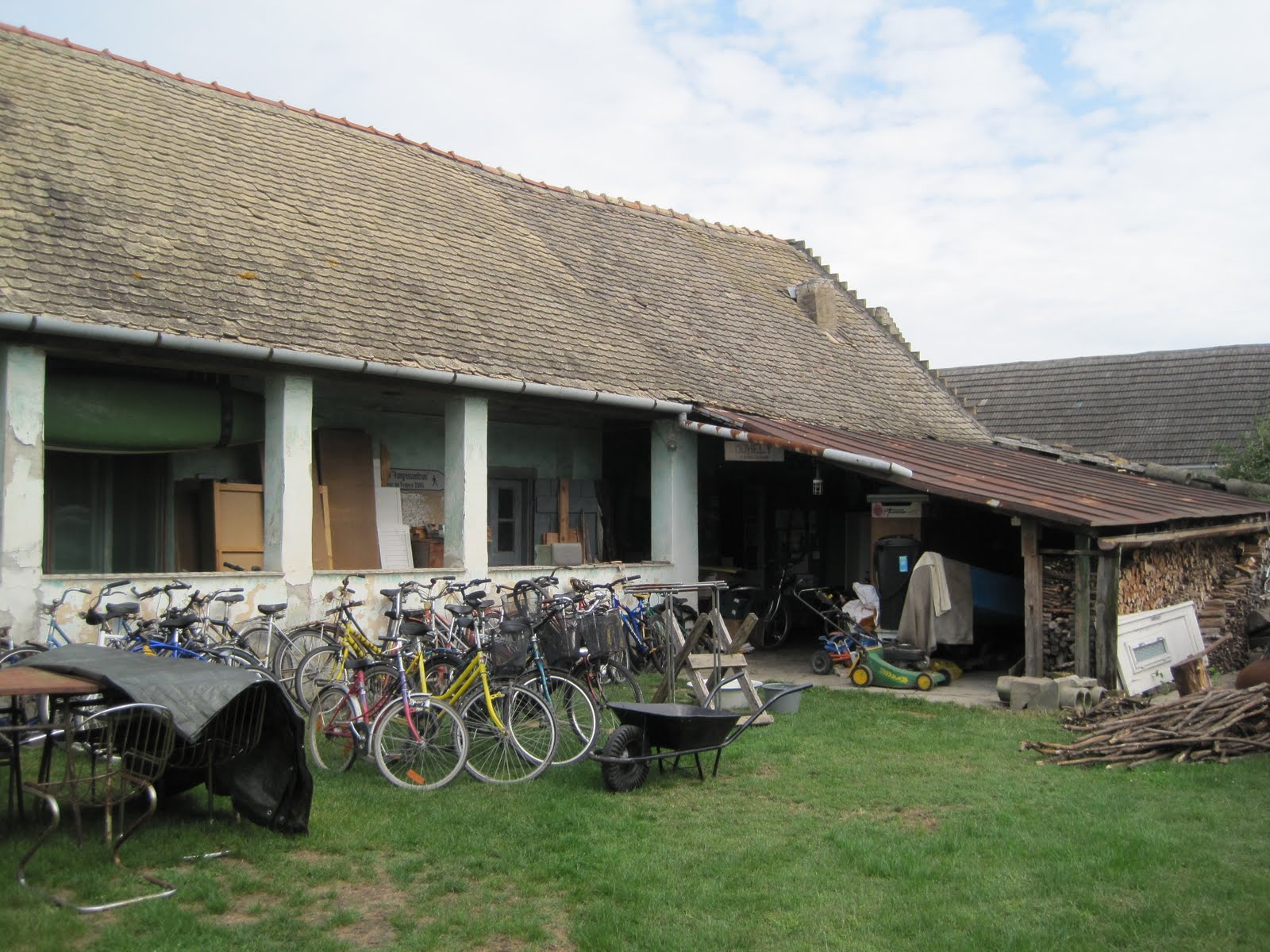
Riding through the small rural town of Batya we were invited in for drink by a fellow cycle tourist, Attila. As far as we could decipher through the langauge barrier he was a cycle mechanic and did up old bikes to sell (he had hundreds of bikes and parts around his house). He showed us a European map on his wall with the plotted journeys he had cycled.  Impressive long rides all over the continent with averages of 140 km a day! He wasn't snobby at all about our slow haphazard trip - he gave us some good advice for routes south and showed us photos from his trips. 
We stayed the night in his garage on our mats next to a wall of ice skates. Perhaps he hires these out in winter? Earlier in the night as he served us blueberry liqueur he excitedly raced to put on a record and came back nodding expectantly. I nodded back politely and tapped my feet not recognizing the reggae pop music. As he changed sides I tried to ask if it was a hungarian group, perhaps a friend's band? I felt such a second rate Australian when he showed me the Men at Work album cover! To be fair on myself it wasnt the record with the Vegemite sandwich song.  He did actually have great taste in music and was excited we liked Kraftwerk and Laurie Anderson as he had all their records. It was great to hear "Trans Euro Express" as I always whistle the tune as we are cycling.
Thanks Attila (köszönöm!!)  we hope we can return your hospitality if you ever make the journey across to Australia!